

How to Store Coffee Beans at Home to Keep Them Fresh
Last Updated: November 7, 2026
Quick Summary
To store coffee beans at home, keep whole beans in an airtight, opaque canister in a cool, dark cabinet, away from the stove, dishwasher, and fridge. For longer storage, freeze beans in sealed single-use portions and thaw them sealed at room temperature.
- Air, heat, light, and moisture are the four enemies that make coffee beans go stale.
- The original bag's one-way valve lets carbon dioxide escape while keeping oxygen out.
- A 12-ounce bag of whole beans fills roughly a 16- to 20-ounce canister with headroom.
- Freeze beans you will not finish within about two weeks, and never freeze pre-ground coffee.
- Buy beans in amounts you will finish in four to six weeks.
Table of Contents
- The Four Enemies of Fresh Coffee Beans
- The Best Container to Store Coffee Beans
- Should I Store Coffee Beans in the Freezer?
- Store Coffee Beans in Fridge or Freezer: Which One Wins
- How to Keep Coffee Beans Fresh for Months
- How to Tell If Your Beans Have Gone Stale
- A Quick Storage Troubleshooting Guide
- Choose Your First Bag of Fresh-Roasted Beans
- Frequently Asked Questions
The Four Enemies of Fresh Coffee Beans
Learning how to store coffee beans at home comes down to defending them against four things: air, heat, light, and moisture. Whole coffee beans start losing aroma the moment they leave the roaster. Every day after that, they fade a little more. What happens next is up to your kitchen.
Here is what each enemy does:
- Air pulls aroma compounds out of the bean and speeds up oxidation, the same browning reaction that turns a cut apple dark.
- Heat pushes oils to the surface and flattens flavor fast.
- Light breaks down the compounds that give coffee its character.
- Moisture invites staleness and off-flavors.
Beans also release carbon dioxide for days after roasting, a process called degassing. That gas needs somewhere to go.
Why the Original Bag With Its One-Way Valve Works
The bag your beans arrived in is better than it looks. Those small plastic valves let carbon dioxide escape while keeping oxygen out. Many roasters design packaging around this, and the Specialty Coffee Association's guidance on coffee freshness treats proper packaging as a core part of quality.
For short-term storage, keep beans in the original bag, press out excess air, and seal it tightly. It is free and it works. The catch: once you open the bag, the clock starts.
The Best Container to Store Coffee Beans
An airtight, opaque canister is a good container to store coffee beans, especially once the original bag is open. It blocks air and light at the same time. Look for a tight silicone or rubber gasket, a solid latch, and a body that keeps light out.
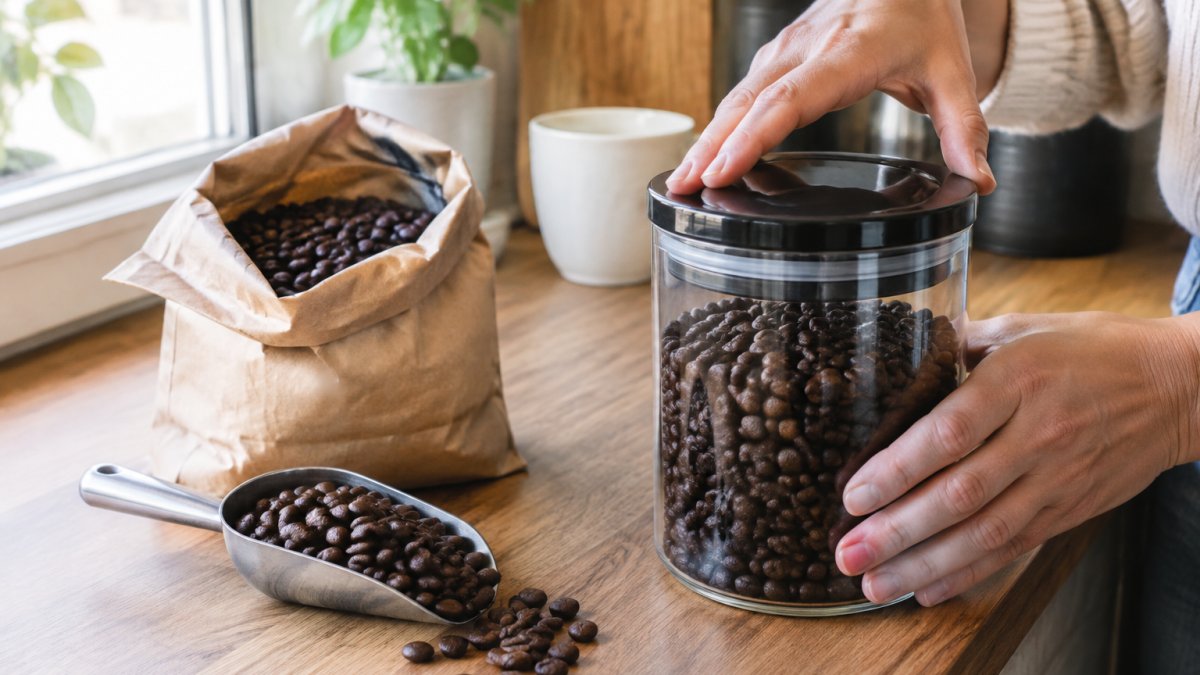
Skip clear glass jars on the counter. They look great and let light straight in. If you love a clear jar, store it inside a cabinet.
Materials, Capacity, and Day-to-Day Use
Match capacity to your habits: a small canister you refill weekly beats a giant one that sits half empty for a month, because every opening swaps fresh air for the gas protecting your beans.
Material trade-offs.
- Stainless steel: Best light block, durable, and easy to wipe clean. It is not transparent, so you cannot see the fill level without opening it, which is actually a plus for freshness. Look for a double-seal lid.
- Ceramic: Excellent light block and attractive on the counter, but heavier and prone to chipping. Confirm the lid gasket is replaceable.
- Opaque or tinted glass: Good light resistance if the tint is dark, and you can see how much is left. Clear glass is the weak choice on a sunny counter.
- Vacuum canisters: These pump air out and can extend freshness, but the pump mechanism adds cost and a failure point. They are most useful for beans you will keep three to four weeks.
- Original valve bag: Free and effective for short holds. The one-way valve lets carbon dioxide escape while limiting oxygen ingress. It is the best default until the bag is opened repeatedly.
Capacity math. A 12-ounce bag of whole beans fills roughly a 16- to 20-ounce canister once you leave headroom for the lid. Size the canister to about one to two weeks of your brewing volume. If you brew one 12-ounce bag every two weeks, a 16-ounce canister is right. If you buy 2-pound bags, split them: keep a week's worth in a small canister and freeze the rest in portions.
Day-to-day use. Keep the canister in a cool, dark cabinet, not next to the stove, dishwasher, or on top of the fridge. Open it only when you are ready to grind, and reseal it fully each time. A canister that is opened five times a day will stale faster than one opened once, no matter how good the seal.
For a deeper comparison of jar types and sizes, see how do you store coffee beans for freshness.
Should I Store Coffee Beans in the Freezer?
Yes, you can freeze coffee beans, and for longer storage it is one of the most reliable methods. Cold slows the staling process dramatically. The rules matter, though: freeze whole beans, never pre-ground coffee, and keep them sealed.
Freeze beans you will not finish within about two weeks. For beans you use daily, a cool cabinet is simpler.
Store Coffee Beans in Fridge or Freezer: Which One Wins
The freezer wins, and it is not close. A fridge is a bad home for coffee for two reasons:
- Fridges hold moisture and strong food odors, and beans absorb both.
- Every door opening swings the temperature, causing condensation on the beans.
If you must choose between the fridge and the freezer, choose the freezer. Keep the fridge for milk.
How to Freeze in Single-Use Portions and Avoid Condensation
Portion first, freeze second. Divide beans into amounts you will brew in a week, seal each portion in an airtight bag, and press out the air. Label each with the roast date.
When you are ready to brew, pull one portion and let it sit sealed on the counter until it reaches room temperature. Opening a cold bag lets moisture condense on the beans. That condensation is the enemy you just spent all this effort avoiding.
How to Keep Coffee Beans Fresh for Months
To keep coffee beans fresh for months, freeze them in sealed single-use portions and open only what you need. That one habit carries most of the load. A few more rules help:
- Buy in amounts you will finish in four to six weeks.
- Keep the daily-use canister in a cool, dark cabinet, away from the stove and dishwasher.
- Never store beans on top of the fridge; that spot runs warm.
- Grind just before brewing to protect flavor.
Our guide to maximizing coffee bean shelf life after roasting covers longer timelines in detail.
Storage Advice by Roast Date, Roast Level, and Packaging
Timing depends on the bean.
Packaging tells you a lot, too. A one-way valve bag signals a roaster who cares about freshness. A plain paper bag does not.
How to Tell If Your Beans Have Gone Stale
Stale beans announce themselves. The clearest signs:
- No aroma when you open the bag or grind.
- Dull, flat, or papery flavor in the cup.
- Oily, tacky surface on beans that were once dry.
- Beans that no longer smell like the roast notes on the label.
Fresh beans smell sweet and complex the moment you open the bag. For a full checklist, read how to tell if coffee beans are fresh.
A Quick Storage Troubleshooting Guide
| Problem | Likely Cause | Fix |
|---|---|---|
| Beans taste flat after a week | Air exposure in a loose bag | Move to an airtight canister |
| Beans smell like last night's leftovers | Stored near food or in the fridge | Relocate to a cool, dark cabinet |
| Oily beans, dull flavor | Heat or long storage | Buy smaller amounts, store cooler |
| Clumped, damp beans after freezing | Opened while still cold | Thaw sealed, at room temperature |
| Aroma gone within days | Clear jar in sunlight | Switch to opaque, airtight storage |
Most fixes cost nothing. They just need a better spot and a tighter seal. If you want to understand why freshness matters so much, our article on the benefits of drinking freshly roasted coffee explains what you gain.
Choose Your First Bag of Fresh-Roasted Beans
Great storage protects great coffee. It cannot rescue beans that were already old when they arrived. That is why we roast to order at Evolve Coffee Company: your bag ships close to its roast date, so you start with more freshness to keep.
Start with our House Blend ($24.99), a smooth medium roast with nutty, sweet chocolate notes and a clean finish. Prefer a single origin? Our Ethiopia Natural ($24.99) brings milk chocolate, fruity, and caramel notes. Want to explore first? The fresh roasted coffee beans online buyer's guide walks you through choosing your first bag.
The real test of any storage routine is a simple one: brew a cup and notice the aroma before you taste it. If you want beans worth protecting, get started with Evolve Coffee Company and taste what roasting to order delivers.
Frequently Asked Questions
What is the best way to store coffee beans at home to keep them fresh?
Keep whole beans in an airtight container or the original bag with its one-way valve, stored in a cool, dark place away from the stove, oven, and direct sunlight. Only grind just before brewing, because pre-ground coffee loses aroma far faster. If you buy more than you will drink in two to three weeks, portion the surplus into small airtight bags and freeze them. This routine keeps oxygen, heat, light, and moisture away from the beans, which is what actually protects flavor.
Should I store coffee beans in the fridge or the freezer?
The freezer is the better choice for long-term storage. A fridge cycles through temperature changes every time the door opens and holds moisture and food odors that beans absorb easily, so store coffee beans in the fridge only if you have no freezer space and plan to use them within a week. For anything longer than a few weeks, freeze in single-use portions, squeeze out the air, and let each portion sit sealed at room temperature before grinding.
Is it okay to store coffee beans in a Ziploc bag?
A standard zip-top bag is better than nothing but not a long-term solution. Thin plastic lets oxygen through over time and does not hold a tight seal once it has been opened and closed repeatedly. If you use one, press out as much air as possible and keep it in a dark cabinet. For daily use, a rigid airtight canister or the original valve bag does a better job of limiting oxygen exposure and protecting the beans from light.
How long do coffee beans stay fresh after opening?
Buying smaller amounts more often beats stocking up. Evolve's House Blend is available at $24.99 per bag.
