

How Do You Store Coffee Beans for Freshness?
Last Updated: October 27, 2026
Quick Summary
To store coffee beans for freshness, keep them in an airtight, opaque container at room temperature, away from the stove and window, and skip the fridge, which adds moisture and odors. Buy only what you'll drink in a few weeks, and freeze bulk purchases in week-sized portions.
- Roasted coffee begins losing quality within days of roasting due to oxygen, moisture, heat, and light.
- Whole bean coffee stays fresh about two to four weeks after the roast date, longer if stored well.
- Match your container to how much you brew in about a week, roughly 1 to 1.5 pounds for a two-cup-a-day household.
- Thaw frozen portions sealed and never refreeze thawed beans, since repeated cycles draw in moisture.
- Check for roast-to-order production, a printed roast date, and packaging with a one-way valve when ordering.
Table of Contents
- The Four Enemies of Coffee Freshness
- How to Store an Open Bag of Coffee Beans
- The Best Coffee Storage Container for Your Kitchen
- How Long Do Coffee Beans Stay Fresh?
- Can You Freeze Coffee Beans? Freezing, Thawing, and Portioning
- Pantry, Fridge, or Freezer: Choosing Where to Store Coffee Beans
- Ordering Beans That Arrive Fresh Enough to Store
- Frequently Asked Questions
The Four Enemies of Coffee Freshness
Learning how to store coffee beans for freshness starts with one fact: roasted coffee begins losing quality within days of roasting. At Evolve Coffee Company, we roast every batch to order. Once beans leave the roaster, four forces start working against them:
- Oxygen pulls flavor compounds apart and turns coffee oils stale
- Moisture soaks into beans and dulls aroma
- Heat speeds up the staling process
- Light breaks down the oils that carry flavor
The USDA guidelines on food storage safety reinforce the same idea for pantry goods broadly: keep things cool, dry, and sealed.
How to Store an Open Bag of Coffee Beans
The best way to store an open bag of coffee beans is to keep them in an airtight, opaque container at room temperature, away from the stove and the window. Air exposure is the enemy once the seal breaks.
Follow these steps:
- Keep beans in the original resealable bag if it has a one-way valve, or move them to a sealed container
- Press out as much air as you can before sealing
- Store the bag in a dark cabinet, not on the counter
- Skip the fridge, which adds moisture and odors
- Buy only what you'll drink in a few weeks
The Best Coffee Storage Container for Your Kitchen
The best coffee storage container is opaque, airtight, and sized to your actual use. Material matters less than the seal, but the material still drives how well the container blocks light and how easy it is to keep clean.
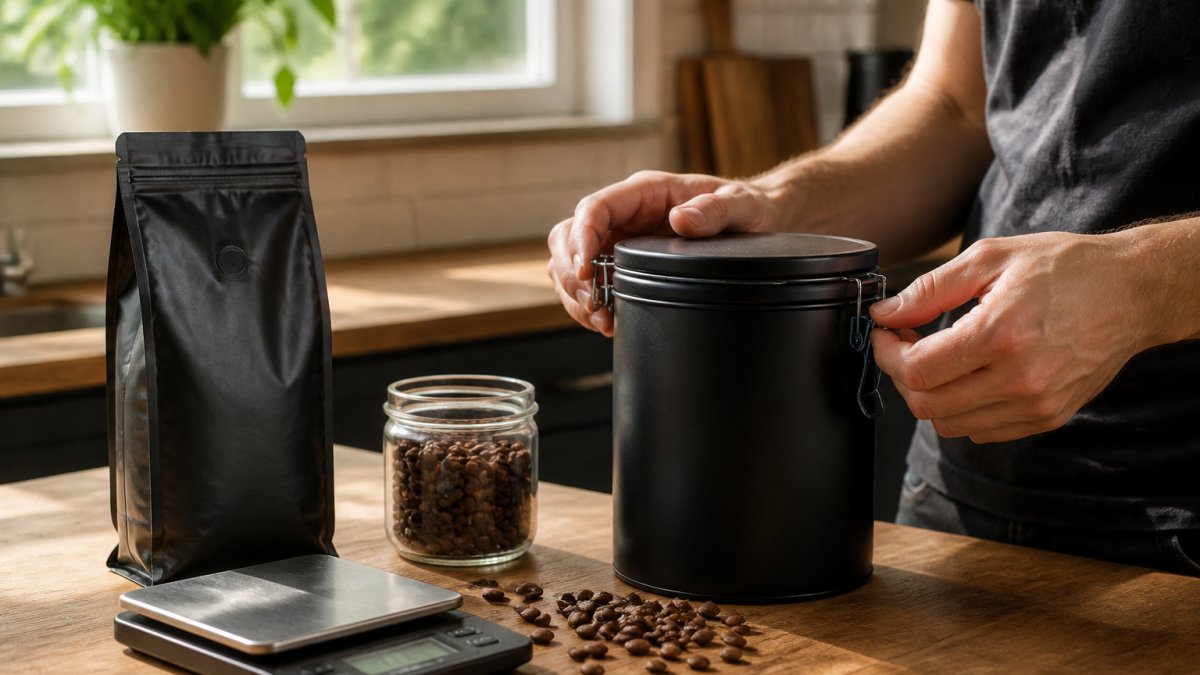
What actually matters, in order
- The seal. A gasket or clamp lid that compresses against the rim is what keeps oxygen out. A loose lid, a cork, or a decorative clasp lets air cycle in every time the temperature shifts. Look for a silicone or rubber gasket and a latch that pulls the lid down evenly.
- Light blocking. Opaque walls (ceramic, stainless steel, tinted glass) beat clear glass on an open shelf. If you love a clear canister, keep it inside a cabinet, not on the counter.
- Headspace. A container that is mostly full of beans and mostly empty of air is the goal. Oversized canisters force you to store beans in a big pocket of oxygen.
- The valve question. A one-way valve lets carbon dioxide escape after roasting without letting oxygen in. It matters most in the first week or two after the roast date. Once beans have degassed, a plain airtight seal is enough.
Material trade-offs
- Stainless steel: Blocks light completely, durable, easy to wipe clean. Can pick up odors if not washed between refills, and you cannot see the bean level.
- Ceramic: Excellent light blocking and stable temperature, but heavy and prone to chipping. Hand-wash only.
- Tinted glass: Blocks some light and lets you see the bean level, but clear or lightly tinted glass still lets light through. Best kept in a cabinet.
- Food-grade plastic: Lightweight and cheap, but many plastics are not truly airtight and can retain coffee oils and odors over time.
Size it to your habit
Match the container to how much you brew in about a week. A common pattern is roughly 1 pound of whole beans per week for a two-cup-a-day household, so a canister in the 1- to 1.5-pound range keeps headspace low without forcing constant refills. If you buy in bulk, portion into smaller containers rather than one giant one.
Cleaning and odor reset
What to skip: clear canisters on open shelves, decorative jars with corks, and anything that lets light through or seals loosely.
How Long Do Coffee Beans Stay Fresh?
Whole bean coffee stays fresh for about two to four weeks after the roast date, longer if stored well. Opened bags fade faster than unopened ones, and ground coffee fades fastest of all.
A rough timeline:
| Storage Method | Approximate Freshness Window |
|---|---|
| Opened bag, pantry, poorly sealed | 1-2 weeks |
| Opened bag, airtight container, dark cabinet | 3-4 weeks |
| Unopened bag with one-way valve | 4-6 weeks |
| Frozen in portions | Several months |
If you're unsure whether your beans have turned, our guide on how to tell if coffee beans are fresh walks through the signs, from dull aroma to oily, faded beans.
Can You Freeze Coffee Beans? Freezing, Thawing, and Portioning
Yes, you can freeze coffee beans, and for bulk purchases it is the best option. The freezer slows the staling reactions that oxygen, heat, and time drive. But freezing only works when you control moisture and repeated temperature swings, which is where most people go wrong.
Freeze or pantry? A simple decision guide
Use this to choose in under a minute:
- You will finish the bag within about a month and it is already open: keep it in the pantry in an airtight, opaque container. Freezing adds handling steps without a meaningful benefit at that pace.
- You bought in bulk, or the bag is unopened and you will not get to it for several weeks: freeze it. Portion first.
- It is a special bag you want to stretch over months: freeze in week-sized portions and pull one at a time.
- The bag is already open and half full: move it to a smaller airtight container in the pantry if you will finish it soon; freeze in portions if not.
Step-by-step freezing
- Portion by use, not by bag. Divide into amounts you will finish in about a week. A common pattern is roughly 1 pound per week for a two-cup-a-day household, so a 5-pound bulk order becomes about five portions.
- Minimize air. Seal each portion in an airtight bag or small jar and press out as much air as you can. Vacuum sealing is ideal if you have it; a heavy-duty freezer bag with the air pressed out works well.
- Label with the roast date. The clock started at roast, not at freezing. Write the date on each portion so you know what you are pulling.
- Freeze at a steady temperature. Keep portions away from strong-smelling foods and away from the door, where temperature swings most.
- Thaw sealed, then open. Pull one portion and let it come to room temperature still sealed. Opening a frozen bag immediately causes condensation, and moisture ruins the beans.
- Never refreeze thawed beans. Repeated freeze-thaw cycles draw moisture in and degrade the oils.
Why portioning solves the problem
A large bag pulled from the freezer, opened, and returned repeatedly goes through small thaw-and-refreeze cycles at the surface of the beans. Portioning means each bag is opened once, at room temperature, and brewed. That is the difference between beans that taste fresh for months and beans that taste flat after two weeks.
What freezing does not fix
Freezing slows staling; it does not reverse it. Beans that were already old when frozen will still taste old when thawed. Start with a printed roast date and freeze soon after the bag arrives.
Pantry, Fridge, or Freezer: Choosing Where to Store Coffee Beans
The pantry wins for daily use. The freezer wins for long-term storage. The refrigerator almost never wins.
Here's the decision guide:
- Pantry if you'll finish the bag within a month. Keep it cool, dark, and sealed.
- Freezer if you bought in bulk or want to stretch a special bag. Portion first.
- Fridge only as a last resort, and only in a truly airtight container. Fridges cycle through temperature fluctuations and humidity, and coffee absorbs nearby odors fast.
Curious about what fresh-roasted coffee actually delivers? Our article on the benefits of drinking freshly roasted coffee covers what changes in the cup.
Ordering Beans That Arrive Fresh Enough to Store
Storage can only protect freshness that's still there when the bag lands. That's the part most buyers overlook: the clock starts at the roast date, not the delivery date.
When you order, check three things:
- Roast-to-order production, so beans ship days after roasting
- A printed roast date on the bag, not just a best-by date
- Packaging with a one-way valve to release gases without letting oxygen in
At Evolve Coffee Company, we roast every batch to order and ship fast so your beans arrive with most of their freshness intact. That matters if you're comparing options: our breakdown of premium coffee beans vs grocery store explains why shelf time changes the cup. Ready to stock your kitchen? Learn how to buy small batch coffee beans online and set up storage the day your order arrives.
Frequently Asked Questions
What are the four enemies of coffee?
Air, moisture, heat, and light. Oxygen causes oxidation, which dulls coffee oils and turns flavor flat. Humidity clumps beans and speeds staling. Heat above room temperature drives off volatile aromatics, and sunlight breaks down the compounds that give coffee its character. Store coffee beans away from all four and you protect aroma and flavor far longer.
Should coffee beans be stored in an airtight container?
Yes. An airtight, opaque container blocks oxygen and light, the two fastest ways coffee goes stale. Keep the original resealable bag inside it if you like, or pour beans straight in and seal the lid after every scoop. Squeeze excess air out of the bag first if you are storing the bag itself. A one-way valve bag works well for degassing, but once opened, an airtight container does more to preserve freshness.
Is it better to store coffee beans in the fridge or freezer?
The freezer, not the fridge. Refrigerators cycle through moist, warm air every time the door opens, and coffee absorbs odors and moisture quickly. Freezing works if you portion beans into airtight bags, remove as much air as possible, and thaw only what you will use. Never refreeze thawed beans, because each freeze-thaw cycle pulls moisture into the beans and degrades flavor.
How long do coffee beans stay fresh after opening?
Whole bean coffee holds peak flavor for about two to four weeks after opening when stored in an airtight container away from heat and light, and it stays drinkable for roughly two to three months. Ground coffee loses freshness much faster, often within a week or two, because more surface area meets oxygen. Check the roast date on the bag, not just the best-by date, to judge how much time you have.
Storing coffee well takes five minutes and saves every bag you buy. If you want beans that start fresh, Evolve Coffee Company roasts to order, ships fast, and prints the roast date so you know exactly what you're storing. Our carefully sourced beans and small-batch roasting deliver maximum flavor and aroma in every cup. Get started with Evolve Coffee Company and taste the difference fresh roasting makes.
