

How to Read a Coffee Roast Date on the Bag?
Quick Summary
The coffee roast date is printed as "Roasted on" followed by a calendar date, usually in a small box near the net weight or on the back or bottom seal. Read the wording beside the date, because best-by, use-by and packed-on dates do not show when the beans were roasted.
- Look for a "Roasted on" date on the front label, then check the back and bottom seal.
- A best-by date is usually set months after roasting, so it can make old coffee look new.
- Whole beans generally taste best roughly 2 to 4 weeks after roasting.
- Ground coffee loses flavor faster, so its best window is a few days to about a week.
- If only a best-by date is printed, ask the roaster for their standard window before estimating.
Table of Contents
- Where to Find the Coffee Roast Date on the Bag
- How to Decode Roast Date Formats and Label Wording
- Roast Date vs. Best-By Date: What Each One Tells You
- What to Do When the Bag Only Shows a Best-By Date
- How Long After the Roast Date Is Coffee Good?
- How to Tell If Coffee Beans Are Fresh
- Storing Your Coffee So It Stays Fresh After You Open It
- Frequently Asked Questions
Coffee's flavor fades fast, and the coffee roast date printed on the bag is the best clue to how fresh your beans really are. Yet many shoppers grab a bag without ever checking it, or mistake a best-by date for a roast date. This guide shows you where to find it, how to read different label formats, and what to do when the bag gives you nothing but a best-by date.
Roast date is the day the beans were roasted, and it is the single most useful freshness marker on a coffee bag. Many roasters print it, often as "Roasted on" followed by a calendar date.
Where to Find the Coffee Roast Date on the Bag
Most roasters print the roast date in a small box or next to the net weight. Look at the front label first, then the sides and back. Many shoppers miss it because it is printed in tiny type.
Checking the Back and Bottom of the Bag
Turn the bag over. The back panel often holds the date code, batch number and roast details. Some bags print the date along the bottom seal or on a sticker near the valve.
Watch out: a date printed on the bottom seal may be the packaging date, not the roast date. Check the wording before you assume.
!Close-up of a hand holding a bag of whole coffee beans under a kitchen light, with the roast date label visible on the back
How to Decode Roast Date Formats and Label Wording
Roasters use different formats, so read the words around the date, not just the numbers. A date alone is ambiguous; the label wording tells you what the date means. Work through the label in this order: find the date, read the phrase next to it, then confirm the format.
Step 1: Find the date and read the phrase beside it
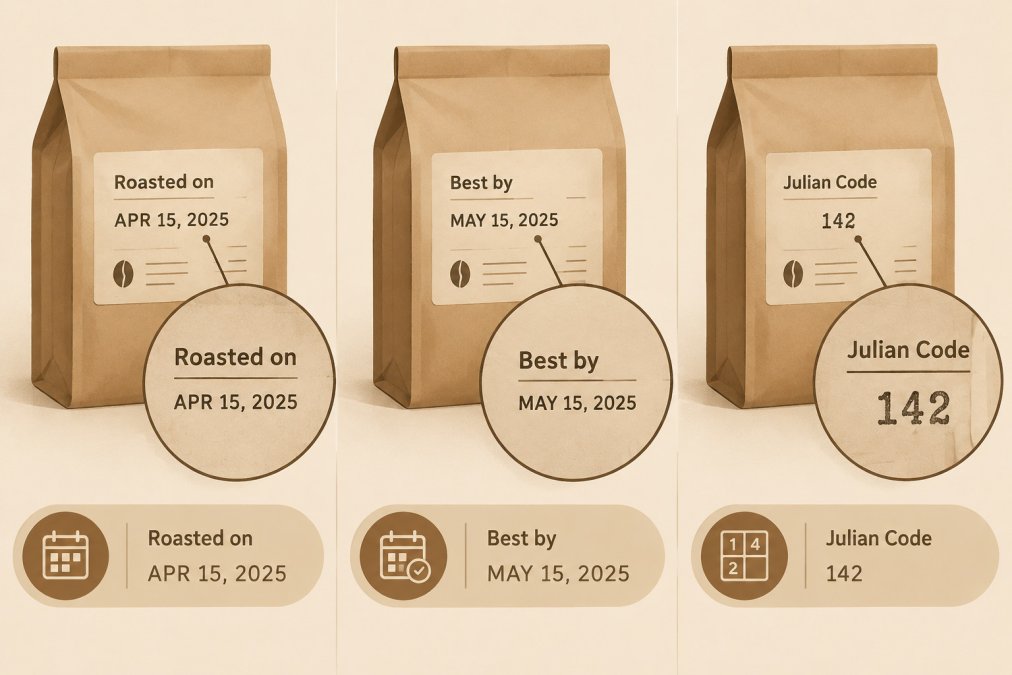
- "Roasted on" + date: This is the roast date. This is the best format to look for.
- "Best by" or "Best before" + date: This is usually set months after roasting. It is not the roast date.
- "Use by" or "Expires": This is a safety-style date, and it tells you little about freshness.
- "Packed on" or "Packaged on": This is when the coffee was bagged, which may be days or weeks after roasting.
- "Sell by": This is a retailer rotation date, not a freshness or roast date.
Step 2: Confirm the date format
U.S. labels most often use month/day/year, so 03/15/26 means March 15, 2026. If the bag does not state the format, confirm with the roaster before you assume.
Common formats you will see:
- 03/15/26 or 3-15-26: Month/day/year in most U.S. labeling.
- Mar 15 2026 or 15 MAR 2026: Month name spelled out, which removes ambiguity.
- 2026-03-15: Year-month-day, often used in batch or inventory systems.
- 03.15.26: Dots instead of slashes, same month/day/year reading in most U.S. cases.
Step 3: Handle codes and ambiguous stamps
- Julian or batch codes: Some roasters use a day-of-year code, such as 074 for March 15. Check the roaster's website for their key.
- Two-digit years: 26 means 2026. If the year is missing entirely, ask the roaster rather than guessing.
- Stamps on the bottom seal or valve: These are often packaging or batch dates, not roast dates. Read the wording before you assume.
Step 4: Know when the label is silent
If the bag shows only a code with no wording, treat it as unreadable until the roaster confirms it. A short email or a question at the counter is faster than guessing wrong. When a bag shows both a roast date and a best-by date, trust the roast date for freshness and use the best-by date only as a quality backstop.
Roast Date vs. Best-By Date: What Each One Tells You
The roast date tells you when the beans were roasted. The best-by date is a packaging guess about when quality may drop. Because best-by dates often sit many months out, they can make old coffee look new.
Many shoppers assume a best-by date of next year means the coffee is fresh. In practice, a bag can carry a long best-by window and still have been roasted months earlier.
What to Do When the Bag Only Shows a Best-By Date
If you see only a best-by date, you can estimate the roast date, but treat the result as rough. Roasters set best-by dates a number of months after roasting, and that window varies by roaster, roast style, and packaging. Because the assumption varies, a reverse calculation is only a rough estimate rather than a dependable method.
How to make a rough estimate
- Check the roaster's website or ask the seller for their standard best-by window.
- Subtract that window from the best-by date.
- Treat the result as a range, not a precise date.
Watch out: if you cannot confirm the roaster's window, the subtraction tells you almost nothing. A bag with a best-by date 10 months out could have been roasted last week or last spring.
A practical decision process for supermarket shoppers
When only a best-by date is shown, compare bags using these steps:
- Look for the latest best-by date on the shelf. A later best-by date usually means a more recent roast, assuming the same roaster and window.
- Check for a roast date elsewhere on the bag. Some bags print it on the bottom seal, the valve sticker, or the back panel even when the front shows only best-by.
- Ask staff when the shipment arrived. A recent delivery is a better freshness clue than a long best-by window.
- Choose another product if the label gives you nothing. If no roast date is printed and staff cannot confirm the window, a bag that states its roast date is the safer choice.
When to walk away
If the best-by date is close to today and no roast date is printed, the coffee is likely older than you want. If the bag is dusty, the valve is damaged, or the beans smell flat when you open it, freshness has probably already faded regardless of the date.
Specialty Coffee Association guidance on coffee freshness and labeling
How Long After the Roast Date Is Coffee Good?
Whole beans generally taste best within a few weeks of roasting, and many people find they keep their best flavor for about one to four weeks. Ground coffee loses flavor faster because more surface area is exposed to air.
These windows vary by roast style and storage. Treat them as general guidance, not a rule for every bag.
- Whole beans: best roughly 2 to 4 weeks after roasting
- Ground coffee: best within a few days to about a week
- Stored well, beans may stay drinkable longer, but flavor usually fades
The window for peak flavor depends on whether the beans are whole or ground.
| Coffee form | Best window after roast | Note |
|---|---|---|
| Whole beans | Roughly 2 to 4 weeks | Flavor fades more slowly than ground |
| Ground coffee | A few days to about a week | Greater surface area speeds staling |
| Stored well | May stay drinkable longer | Flavor usually still fades |
How to Tell If Coffee Beans Are Fresh
Check the roast date first. Then use your senses. Fresh beans smell rich and aromatic when you open the bag. Stale beans smell flat, dusty or cardboard-like.
Some shoppers find that very fresh beans bloom strongly when hot water hits them. This is a helpful sign, though it does not prove freshness on its own.
Storing Your Coffee So It Stays Fresh After You Open It
Air, light, heat and moisture all speed up staling. Once you have the beans home, store them in an airtight container away from the stove and sunny windows.
Keep the beans at room temperature. The refrigerator and freezer can add moisture when you open the container, which can dull flavor. If you freeze beans, portion them into small amounts so you thaw only what you need.
Grind just before brewing when you can. Whole beans hold their flavor far longer than pre-ground coffee.
Freshness is easiest to check when a bag shows a roast date you can trust. Browse our current selection of freshly roasted coffee and choose the bag that fits your next morning routine.
Frequently Asked Questions
How long after the roast date is coffee good?
Most roasters suggest whole beans are at their best roughly 2 to 4 weeks after roasting, while ground coffee loses aroma faster and is best used within a few days to a week. Freshness is a matter of flavor rather than safety, so coffee roasted months ago is usually still drinkable but will taste flatter. Pricing and delivery timing vary by order, so check Evolve Coffee Company's website for current details.
Is coffee roasted 4 months ago still good?
Coffee roasted four months ago is generally still safe to drink, but it will usually taste dull compared with beans roasted within the last few weeks. Aroma and sweetness fade as the beans lose carbon dioxide and oils oxidize, especially after the bag is opened. If the beans smell flat, sour or cardboard-like, they are past their prime. Storing them airtight and away from heat and light slows this loss, though it does not reverse it.
What should I do if my coffee bag only has a best-by date?
A best-by date tells you when the seller expects the product to remain at its intended quality, but it does not state when the coffee was roasted. If a best-by date is the only date printed, you can work backward by assuming a roast date is usually several months before that date, though the exact gap varies. Ask the seller for the roast date if it is not printed. When you cannot get that information, judge freshness by smell, appearance and the bag's sealing, and buy smaller quantities more often.
How can I tell if coffee beans are fresh?
Fresh whole beans have a strong, pleasant aroma when you open the bag, a slightly oily surface on darker roasts, and a clear, crisp smell rather than a stale or papery one. Recently roasted beans may also release a little gas, which shows up as a slight puff when the bag is opened. Beans that look dull, smell of nothing, or taste hollow when brewed are likely past their best. Checking the roast date against the freshness window is the most reliable way to decide.
