

Single Origin Coffee Subscription for Beginners
Last Updated: October 29, 2026
Quick Summary
A single origin coffee subscription for beginners delivers one traceable coffee at a time instead of a blend, so you learn what you like and build a palate on purpose. Match delivery frequency to how much you actually drink, and treat penalty-free skip, pause, and cancel as a baseline requirement.
- Start with a medium roast if you drink coffee with milk or sugar; go medium-light if you drink it black.
- A 12-ounce bag holds about 340 grams, roughly a three-to-four-week supply for one cup a day.
- A hand burr grinder in the $40-$60 range is the highest-leverage purchase for beginners.
- Use a 1:16 coffee-to-water ratio by weight, about 20 grams of coffee to 320 grams of water.
- Write three tasting words per cup and log origin, process, and roast level to spot your preferences.
Table of Contents
- What Is Single-Origin Coffee and Why It Suits Beginners
- How to Choose Coffee Beans for Your First Subscription
- Coffee Subscription Frequency: Matching Deliveries to Your Pace
- How to Brew Single-Origin Coffee at Home Without Guesswork
- Freshness, Storage, and the Shelf Life of Your Beans
- A Beginner's Decision Framework for Picking a Subscription
- Start Your First Single-Origin Order with Evolve Coffee Company
- Frequently Asked Questions
What Is Single-Origin Coffee and Why It Suits Beginners
Single origin coffee is coffee traced to one growing region, farm, or producer group rather than blended from multiple countries.
Most guides tell beginners to start with a "safe" blend. We think that's backwards. A blend hides its components, so you never learn which origin produced the flavors you enjoyed.
Origin flavor fades with time, and coffee loses aromatics the longer it sits after roasting, which is why freshness matters so much for single-origin beans.
Single-Origin vs. Blends: What the Label Tells You
A single-origin label tells you the coffee comes from one place. A blend label tells you nothing about proportions or components. That's the difference that matters when you're learning.
Single-origin coffees let you taste a place: an Ethiopia from the Sidama Zone and a Brazil Santos from Parana each carry the character of their origin.
Watch out: some bags labeled "single origin" only name a country.
How Origin, Variety, Processing, and Roast Shape Flavor
Four variables decide what lands in your cup, and understanding them turns random sipping into actual learning.
- Origin and growing region: Altitude, soil, and climate set the baseline. Higher-altitude coffees tend to develop more acidity and complexity.
- Variety: Bourbon, Caturra, Typica, and indigenous heirloom cultivars each bring different character.
- Processing method: Washed coffees taste clean and structured; natural coffees, dried in the fruit, taste fruitier and heavier; honey sits between the two.
If you want a concrete example of how processing changes a cup, look at an Ethiopia Natural: full natural process, dried on raised beds, and the tasting profile reads milk chocolate, fruity, caramel. That fruit-forward character is the processing talking, not just the country.

How to Choose Coffee Beans for Your First Subscription
Choosing beans for a first subscription comes down to three decisions: roast level, format, and whether you want a fixed coffee or a rotating selection. Get those right and the rest is refinement.
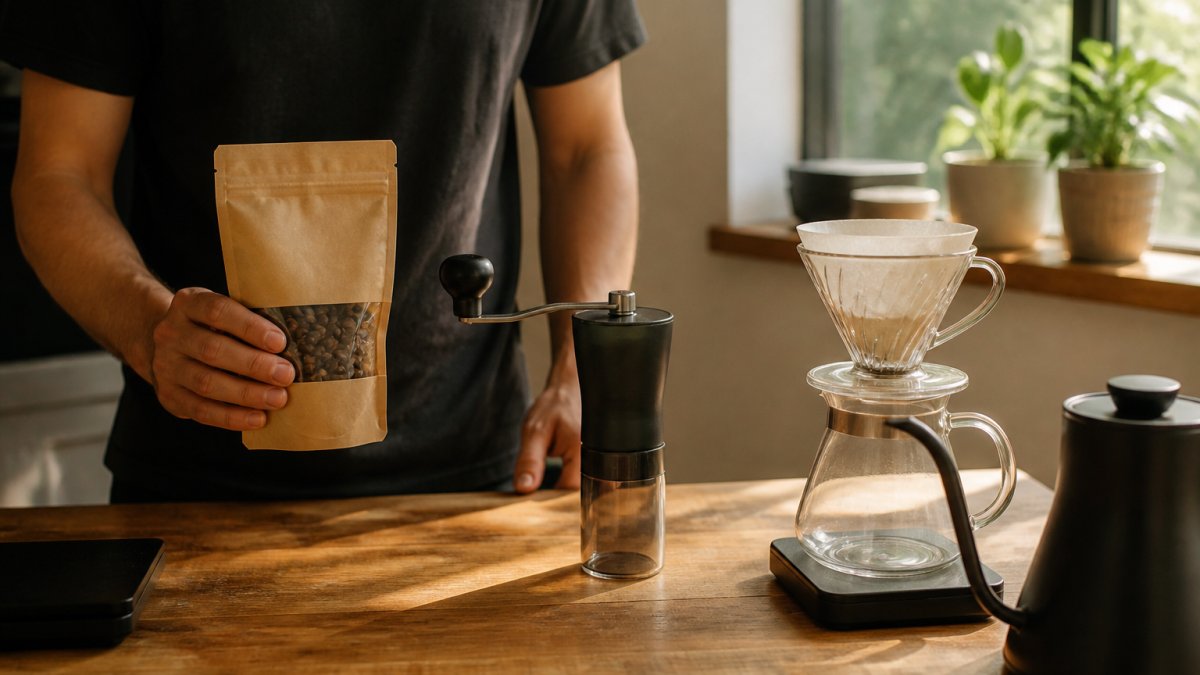
Start with roast level. If you drink your coffee with milk or sugar, a medium roast is the safest entry point.
Format is next. Whole beans stay fresh longer and let you grind to match your brew method; pre-ground is convenient but goes stale faster.
For a first bag, we'd point most people toward something approachable and balanced rather than the wildest option on the menu. A Colombia with notes of dried orange, berry, and chocolate is a friendly starting point: medium roast, fully washed, and forgiving across brew methods.

Coffee Subscription Frequency: Matching Deliveries to Your Pace
Match delivery frequency to how much coffee you actually drink, not how much you'd like to drink. A subscription that outpaces your consumption leaves bags sitting in the cabinet, and stale beans defeat the entire purpose.
Do the bag-size math before you pick an interval
Here's the arithmetic:
- Weigh one day's dose. A standard mug of drip or pour-over uses roughly 15-20 grams; a 12-ounce cup lands near 18 grams. A double espresso is about 18 grams in and roughly 36 grams out.
- Multiply by brew days. One cup a day, five days a week, is about 90 grams a week, call it 360-400 grams a month.
- Compare to bag size. A 12-ounce bag holds about 340 grams; a 1-pound bag about 454 grams. So a 12-ounce bag is roughly a three-to-four-week supply for a one-cup-a-day drinker, and a 1-pound bag stretches to five or six weeks.
- Set the interval one step slower than the math suggests. Most people overestimate first-month consumption, and a bag that arrives before you finish the last one becomes stale inventory.
Read the flexibility terms like a contract
Delivery frequency is only half the story; the other half is what happens when life changes. Before you commit, confirm these five terms in writing:
- Skip: Can you skip a single delivery without canceling? How far ahead must you decide?
- Pause: Can you pause for a month or two and resume at the same price?
- Cancel: Is cancellation self-serve online, or does it require an email or phone call? Are there penalties or minimum-order commitments?
A roaster confident in its coffee doesn't need to trap you in a contract. Treat penalty-free skip, pause, and cancel as a baseline requirement, not a bonus.
Calculate the real cost per cup
Price per bag is misleading because bag sizes vary. Divide the total delivered price (bag plus shipping) by the cups the bag yields. A 12-ounce bag at roughly 18 grams per cup makes about 18-19 cups; a 1-pound bag makes about 25. If a $20 bag with $5 shipping yields 18 cups, you're near $1.39 per cup, often below a chain café drip and well below a latte.
Match frequency to your learning goal, too
Frequency isn't only about supply. A beginner building a palate benefits from tasting a new origin every few weeks rather than drinking the same bag for two months. If your consumption is low, a smaller bag on a shorter interval beats a large bag on a long one, more origins per dollar and fresher coffee each time.
How to Brew Single-Origin Coffee at Home Without Guesswork
Brewing single-origin coffee at home is mostly a matter of holding variables steady so you can taste what changed between bags. Change one thing at a time, and keep notes. A subscription only teaches you something if you can evaluate what arrives.
Single Origin Favorites Sample Pack →
A beginner setup that doesn't require specialty gear
You do not need a scale, a gooseneck kettle, and a $200 grinder to start. You need four things, in this order of impact:
- A burr grinder. This is the highest-leverage purchase. A hand burr grinder in the $40-$60 range produces a far more even grind than a $20 blade grinder, and even grind is the difference between sour-and-bitter muddle and a clean cup. If you truly can't grind, buy pre-ground and accept a faster decline in aroma.
- A brewer you'll actually use. A drip machine with a showerhead and thermal carafe is fine. A pour-over dripper (V60 or similar) costs under $15 and gives more control. A French press is the most forgiving for coarse grinds. Pick one and stop shopping.
- A kitchen scale. A $15 digital scale lets you use weight ratios instead of scoops, the biggest consistency upgrade after the grinder.
- Good water. Coffee is roughly 98% water. If your tap water tastes strongly of chlorine or minerals, filtered water will improve the cup more than a new brewer.
The starting recipe
Use these as defaults, then adjust:
- Ratio: 1 part coffee to 16 parts water by weight. For a 12-ounce (about 355 ml) cup, that's roughly 20 grams of coffee to 320 grams of water.
- Grind: medium-fine for pour-over, medium for drip, coarse for French press. If the brew drains too fast and tastes sour, grind finer; if it stalls and tastes bitter, grind coarser.
- Water temperature: just off the boil, roughly 195-205°F. Without a thermometer, boil and wait about 30 seconds.
A common mistake is changing three variables at once and then blaming the coffee. If a cup tastes sour or thin, grind finer or extend the brew; if it tastes bitter or harsh, do the opposite. That single rule solves most beginner problems.
How to actually taste a single-origin coffee
This is the step most subscription guides skip, and it's the one that turns deliveries into knowledge. You don't need formal cupping training, just a repeatable routine.
- Smell before you sip. Wet the grounds, wait 30 seconds, and smell the steam. Note the first two or three words that come to mind, fruit, chocolate, floral, nut, spice.
- Slurp, don't sip. A small, noisy slurp spreads coffee across your palate and sends aroma up the back of your nose, where most flavor is perceived.
- Check four axes: sweetness (sugary or flat?), acidity (bright and juicy, or dull?), body (thin like tea or heavy like syrup?), and finish (does the flavor linger or vanish?).
- Write three words per cup. Over a few deliveries, patterns emerge: you'll notice you consistently prefer washed, higher-acidity coffees, or that natural-process fruit notes aren't for you.
- Compare side by side when you can. Brew two origins in the same session, same recipe, and taste them back to back. The difference is far easier to detect than from memory.
Interpret the roaster's tasting notes
Tasting notes are a guide, not a guarantee. "Milk chocolate, fruity, caramel" on an Ethiopia Natural describes the impression the roaster got from a specific roast batch; your grinder, water, and recipe will shift it. Use the notes to set expectations and compare against your own log, not as a pass/fail test. If you taste berry where the bag says caramel, that's your palate and your brew doing their job.
Freshness, Storage, and the Shelf Life of Your Beans
Freshness is the variable beginners underestimate most. Coffee is an agricultural product, and its aromatics decline from the moment roasting finishes.
Store beans in an airtight container, away from light, heat, and moisture. Skip the freezer for daily-use beans; repeated temperature swings do more harm than good.
If you're weighing whether the upgrade from supermarket coffee is worth it, our comparison of premium coffee beans vs grocery store options covers the freshness and quality differences directly.
A Beginner's Decision Framework for Picking a Subscription
Use this framework to compare any subscription on offer. Score each factor, then pick the option that fits your actual habits rather than the most impressive-sounding one.
| Decision Factor | What to Check | Why It Matters |
|---|---|---|
| Roast level range | Does it offer medium and light roasts? | Origin character shows through lighter roasts |
| Rotation style | Fixed selection or rotating coffees? | Rotation builds your palate faster |
| Bag size | Matches your monthly consumption? | Oversized bags go stale before you finish |
| Delivery frequency | Can you skip or pause? | Flexibility prevents wasted coffee |
| Roast date | Printed on the bag? | Freshness you can verify |
| Origin detail | Region, farm, process listed? | Traceability signals real sourcing standards |
| Cancellation terms | Clear and penalty-free? | No lock-in means no risk in trying |
Before committing to a full subscription, decide what "ethically sourced" needs to mean for you. Our guide to what ethically sourced coffee means explains the certifications and sourcing language worth looking for.
Start Your First Single-Origin Order with Evolve Coffee Company
The fastest way to learn what you like is to taste several origins side by side, and that's what a sample pack is for. Our Single Origin Favorites Sample Pack includes six 2-ounce packs spanning Brazil Santos, Colombia, Costa Rica, Ethiopia, Honduras, and Tanzania, so you can compare a washed Colombian against a natural Ethiopian in the same week and finally hear the difference everyone talks about.

Every Evolve Coffee Company order is roasted to order and shipped fast, so the bag that arrives is close to its roast date rather than its expiry. Single-origin coffee only rewards you if it's fresh.
Get started with Evolve Coffee Company and find the origin that makes your morning worth waking up for.
Frequently Asked Questions
What does single-origin coffee mean?
Single-origin coffee comes from one growing region, farm, or producer rather than a blend of multiple sources. That traceability lets you taste the character of a specific place, variety, and processing method. For example, the Ethiopia Natural from Evolve Coffee is grown by smallholder farmers in the Sidama Zone and processed naturally, which builds fruity, caramel notes. Beginners benefit because each bag teaches you something concrete about flavor instead of masking differences in a blend.
Is single-origin coffee good for beginners?
Yes, and it may be the fastest way to learn what you like. Because each bag comes from one origin, you can compare a washed Colombia against a natural Ethiopia and notice how processing changes the cup. Start with medium roasts, which are forgiving across brew methods. A sample pack, like Evolve Coffee's Single Origin Favorites Sample Pack with six 2-ounce packs for $24.99, lets you taste several origins before committing to a full bag.
How do I choose a coffee subscription?
Match the subscription to your drinking volume and curiosity. Check the roast date policy, bag size, delivery frequency, and whether you can skip, pause, or cancel without penalty. Look for roasters that roast to order, since freshness drives flavor. Evolve Coffee roasts every batch to order and offers single-origin bags at $24.99, plus a sample pack for $24.99, so you can test the quality before setting a recurring schedule.
Should beginners buy whole-bean or ground coffee?
Whole beans stay fresh longer and let you adjust grind size for your brew method, which matters for single-origin coffee. If you do not own a grinder, ask the roaster to grind for your method and plan to finish the bag within a few weeks. A burr grinder is the single best upgrade for a beginner setup. Store beans in an airtight container away from light and heat, and grind just before brewing for the clearest flavor.
How often should a coffee subscription deliver?
Match coffee subscription frequency to how much you drink. A common starting point is one 12-ounce bag every two weeks for one daily cup, or every four weeks for a few cups a week. Choose a schedule you can finish before the next delivery so nothing sits stale.
How do you brew single-origin coffee at home?
Start with a consistent recipe: a medium grind, water just off the boil, and a 1:16 coffee-to-water ratio by weight. A pour-over or drip brewer works well for beginners. Bloom the grounds with a small amount of water for 30 seconds, then pour in stages. Adjust grind finer if the cup tastes sour and coarser if it tastes bitter. Try the Brazil Santos, a medium roast with cocoa notes, as a forgiving first bag.
The hardest part of a coffee subscription isn't choosing one. It's learning to taste deliberately instead of drinking on autopilot. If you want the shortcut, start with a sample pack, brew each bag the same way, and write down three words per cup. Evolve Coffee Company roasts to order, ships fast, and sources beans with the region, farm, and processing method printed on every bag, so the learning curve is the only thing between you and a genuinely better cup.
