

The Best Way to Brew Morning Coffee: A Practical Guide
Table of Contents
- The Best Way to Brew Morning Coffee Starts With Your Schedule
- How to Make Coffee From Beans at Home: The Four Core Methods
- What Is the Best Coffee Brewing Method for Your Morning?
- Nail Your Coffee-to-Water Ratio for Repeatable Results
- Grind Size, Water Temperature, and Water Quality Troubleshooting
- How to Make Coffee Ahead of Time Without Losing Flavor
- Cleanup, Maintenance, and Total Cost of Ownership
- Frequently Asked Questions
Last Updated: October 20, 2026
The Best Way to Brew Morning Coffee Starts With Your Schedule
The best way to brew morning coffee is the method that fits your actual morning, not the one that looks best on a video. At Evolve Coffee Company, we roast to order for people who treat their first cup as a ritual, and we've learned that ritual only survives if it matches your clock.
Here's the honest truth: most brewing guides assume you have twenty quiet minutes. You probably don't.
So start with time, not taste. Below, we'll show you four methods, exact ratios, and a selector table so you can pick once and stop second-guessing. A good morning coffee routine should feel easy, not like a chore you skip by Wednesday.
How to Make Coffee From Beans at Home: The Four Core Methods
Learning how to make coffee from beans at home comes down to four methods: French press, drip, pour-over, and cold brew. Each one trades effort for control in a different way.
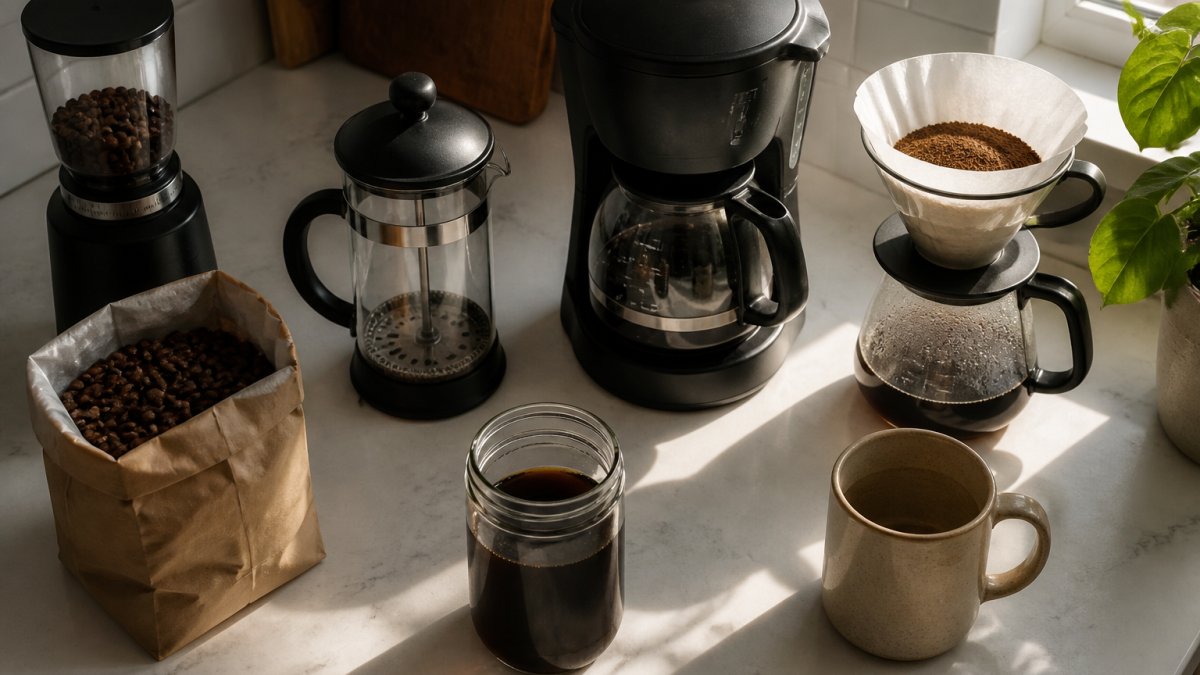
You need three things for all four: fresh whole beans, a grinder, and clean water. Freshness matters most. Beans start losing aroma soon after roasting, which is why we roast every batch to order.
French Press: Full-Bodied and Forgiving
The French press, also called a press pot, is the most forgiving beginner method. You steep coarse grounds in hot water, then press the filter down.
It rewards rough measurements and doesn't punish small mistakes. Expect a rich, full body with some sediment in the cup.
- Grind: coarse, like sea salt
- Brew time: about 4 minutes
- Cleanup: rinse the pot, compost the grounds
Drip Coffee: Hands-Off and Consistent
A drip coffee maker does the work while you get ready. Load a filter, add grounds and water, press start.
Consistency is the selling point. The trade-off is less control over flavor. Choose a machine with a showerhead that wets grounds evenly.
- Grind: medium
- Brew time: 5 to 8 minutes
- Cleanup: toss the filter, rinse the carafe
Pour-Over: Control and Clarity
Pour-over gives you the most control and the cleanest cup. You pour hot water over medium-fine grounds in stages, and the result is bright and clear.
It's also the least forgiving. A sloppy pour shows up in the taste. This method suits tinkerers who enjoy the process.
- Grind: medium-fine
- Brew time: 3 to 4 minutes
- Cleanup: filter and a quick rinse
Cold Brew: Smooth and Make-Ahead Friendly
Cold brew steeps coarse grounds in cold water for 12 to 18 hours. The result is smooth, low-acid coffee concentrate you dilute with water or milk.
It's the ultimate make-ahead option. Brew a batch on Sunday and pour all week.
- Grind: coarse
- Brew time: 12 to 18 hours
- Cleanup: strain and rinse the jar
What Is the Best Coffee Brewing Method for Your Morning?
The best coffee brewing method is the one that matches your weekday time, taste, cleanup tolerance, and budget. Most guides stop at a four-row table. This one gives you a tested starting recipe for each method plus the trade-offs that actually decide whether you'll still be using it in a month.
Side-by-Side Method Selector
Use this table to decide in under a minute. Every recipe below assumes a 12-ounce (about 355 ml) finished cup unless noted, and every dose is in grams because scoops vary too much to repeat.
| Method | Active Time | Total Time | Dose | Water | Grind | Water Temp | Taste | Cleanup | Caffeine per 12 oz | Gear Cost (typical) |
|---|---|---|---|---|---|---|---|---|---|---|
| French press | 5 min | ~9 min | 22 g | 355 g | Coarse (sea salt) | 195-205°F | Full-bodied, rich, some sediment | Rinse pot, compost grounds | ~120-150 mg | $20-$40 |
| Drip | 2 min | 5-8 min | 20 g | 355 g | Medium | 195-205°F (machine-dependent) | Consistent, smooth | Toss filter, rinse carafe | ~95-120 mg | $30-$150 |
| Pour-over | 6 min | ~7 min | 20 g | 340 g | Medium-fine | 195-205°F | Bright, clear | Toss filter, quick rinse | ~95-120 mg | $15-$40 |
| Cold brew | 10 min prep | 12-18 hr steep | 40 g (concentrate) | 240 g | Coarse | Cold (room temp water) | Smooth, low-acid | Strain once, rinse jar | ~150-200 mg (diluted 1:1) | $15-$35 |
Caffeine figures are approximate and depend on bean, roast, and steep time; darker roasts do not contain more caffeine by weight than lighter roasts, though they taste less bitter.
Pick by Morning Type
- Rushed weekday, 5 minutes or less: drip. Load it the night before, press start, walk away. Active time is under 2 minutes.
- Hands-off but better flavor: cold brew concentrate. Ten minutes of prep on Sunday yields four to five weekday servings.
- You want a strong, heavy cup and don't mind a rinse: French press. It forgives rough measurements better than any other method.
The One Rule That Beats the Table
Whichever method you pick, weigh your beans and use filtered water. Those two habits matter more than the brewer. A $20 French press with a $15 scale and a $25 filter pitcher will out-brew a $150 machine used with tap water and eyeballed scoops.
Nail Your Coffee-to-Water Ratio for Repeatable Results
The coffee-to-water ratio is the number that makes your cup repeatable. Start with 1 gram of coffee per 16 grams of water, roughly a 1:16 brew ratio. That's about 2 tablespoons of ground coffee per 6 ounces of water.
From there, adjust to taste:
- Want it stronger? Tighten to 1:14.
- Want it lighter? Loosen to 1:17.
- Using a scale? Weigh beans, not scoops. It's the fastest way to consistency.
A common mistake is eyeballing grounds in a scoop. Scoop size varies wildly, so your cup changes every day. A cheap kitchen scale fixes this for good.
Grind Size, Water Temperature, and Water Quality Troubleshooting
Three variables ruin more morning coffee than bad beans: grind size, water temperature, and water quality. Fix these and most problems disappear.
- Too bitter? Your grind is too fine or your water too hot. Coarsen the grind or let water cool slightly.
- Too sour? Your grind is too coarse or you're under-extracting. Grind finer or steep longer.
- Weak and watery? Add more coffee, not more time.
According to water quality guidance from the CDC, home water treatment varies widely, so a simple filter is a smart baseline. If your coffee tastes off and the beans are fresh, suspect the water next.
How to Make Coffee Ahead of Time Without Losing Flavor
You can make coffee ahead of time if you store it right. Cold brew is the easiest win: brew concentrate once, keep it sealed in the fridge, and dilute by the cup.
For hot coffee, brew a batch and store it in an airtight carafe. Reheat gently and skip the microwave on high, which scalds the flavor.
A few rules that protect flavor:
- Cool hot coffee quickly before refrigerating
- Store in an airtight container, not an open pot
- Keep cold brew concentrate sealed and cold
Cleanup, Maintenance, and Total Cost of Ownership
Cleanup and upkeep decide which method you'll still be using in a year. Most guides describe the brewing step and skip the part that happens after, the rinse, the descale, the strainer, the bean bill. Here is the ownership picture for each method, in minutes and dollars.
Daily Cleanup and Maintenance Intervals
- French press: rinse the pot and filter mesh after every use (about 1 minute). Deep-clean the mesh with a soft brush and dish soap weekly to clear oils that turn rancid. Replace the mesh or plunger seal when the press starts letting grit through, typically every 12 to 24 months with daily use.
- Drip: toss the filter and rinse the carafe daily (about 1 minute). Descale the machine every 1 to 3 months depending on water hardness, using a descale solution or a 1:1 white vinegar and water cycle followed by two plain-water cycles. Replace the water filter cartridge if your machine has one, per the manufacturer's interval.
- Pour-over: toss the filter and rinse the cone daily (under 1 minute). Wash the cone weekly with dish soap to remove oils. The cone itself lasts years; the only recurring cost is filters.
Total Cost of Ownership, Per Cup
The real cost is beans, not gear. Whole beans typically run $12 to $20 per 12-ounce bag, which yields roughly 20 to 30 cups at a 20-gram dose. That works out to roughly $0.50 to $1.00 per cup for the coffee itself, before milk or sweetener. A café cup at $4 to $6 makes the home habit pay for itself within weeks.
- French press: $20-$40 gear, near-zero recurring cost beyond beans and a replacement mesh every year or two. Lowest total cost of ownership.
- Drip: $30-$150 gear, plus paper filters (a few cents per cup) and descale solution a few times a year. Highest upfront cost, lowest active time.
- Pour-over: $15-$40 gear, plus paper filters at a few cents per cup. Cheapest entry point and easiest to keep clean.
The Hidden Costs Most Guides Skip
- Grinder: a burr grinder is the single biggest quality upgrade and costs $40 to $150 for a reliable entry-level model. Blade grinders are cheaper but produce uneven particles that make every method taste worse.
- Scale: a $15 to $25 kitchen scale is the cheapest way to make your cup repeatable.
- Water filter: a pitcher filter runs $20 to $40 plus $10 to $20 per replacement cartridge every couple of months. Filtered water protects both flavor and your machine.
Frequently Asked Questions
What is the best way to brew morning coffee if I'm short on time?
A drip coffee maker is the fastest hands-off option: load the filter and grounds the night before, then press start when you wake up. A French press takes about four minutes of steeping plus a quick plunge, so it fits a rushed morning too. Cold brew concentrate made on the weekend is the lowest-effort weekday option, since you just dilute it with water or milk and heat or ice it. Match the method to your available minutes, not to what looks most impressive.
What coffee-to-water ratio should I use for morning coffee?
Start with roughly 1 gram of coffee per 16 to 17 grams of water, which lands near a 1:16 brew ratio. In kitchen terms, that is about 2 tablespoons of ground coffee for every 6 ounces of water. French press and pour-over both work well in that range. Cold brew concentrate uses a tighter ratio, often 1:4 or 1:5, then gets diluted to taste. Adjust in small steps: a little more coffee for a stronger cup, a little less for a smoother one, and keep notes so the result repeats.
Should I grind coffee beans right before brewing?
Yes. Grinding right before you brew preserves aroma and flavor, because ground coffee loses volatile compounds quickly once exposed to air. Whole beans stay fresher longer in a sealed container away from light and heat. Grind size should match your method: coarse for French press and cold brew, medium for drip, and medium-fine for pour-over. If you cannot grind daily, grind a small batch for a few days at most and store it airtight.
Can I make coffee ahead of time and still get a good cup?
You can, with the right method. Cold brew is the most forgiving: steep it for 12 to 16 hours, strain it, and keep the concentrate in the fridge for several days. For hot coffee, brew a batch and store it in an insulated carafe rather than on a hot plate, which keeps cooking the coffee and turns it bitter. Avoid leaving brewed coffee at room temperature for long stretches. Reheat gently and expect a slightly softer flavor than a fresh cup.
Your morning coffee only feels effortless when the method, ratio, and gear all fit your real schedule. If you want a cup that tastes noticeably better without adding steps, start with fresher beans. Evolve Coffee Company roasts every batch to order for maximum flavor and aroma, delivers fast and reliably, and offers single-origin beans and blends to match any brewing method. Shop Coffee with Evolve Coffee Company and give your morning routine a smoother, richer start.